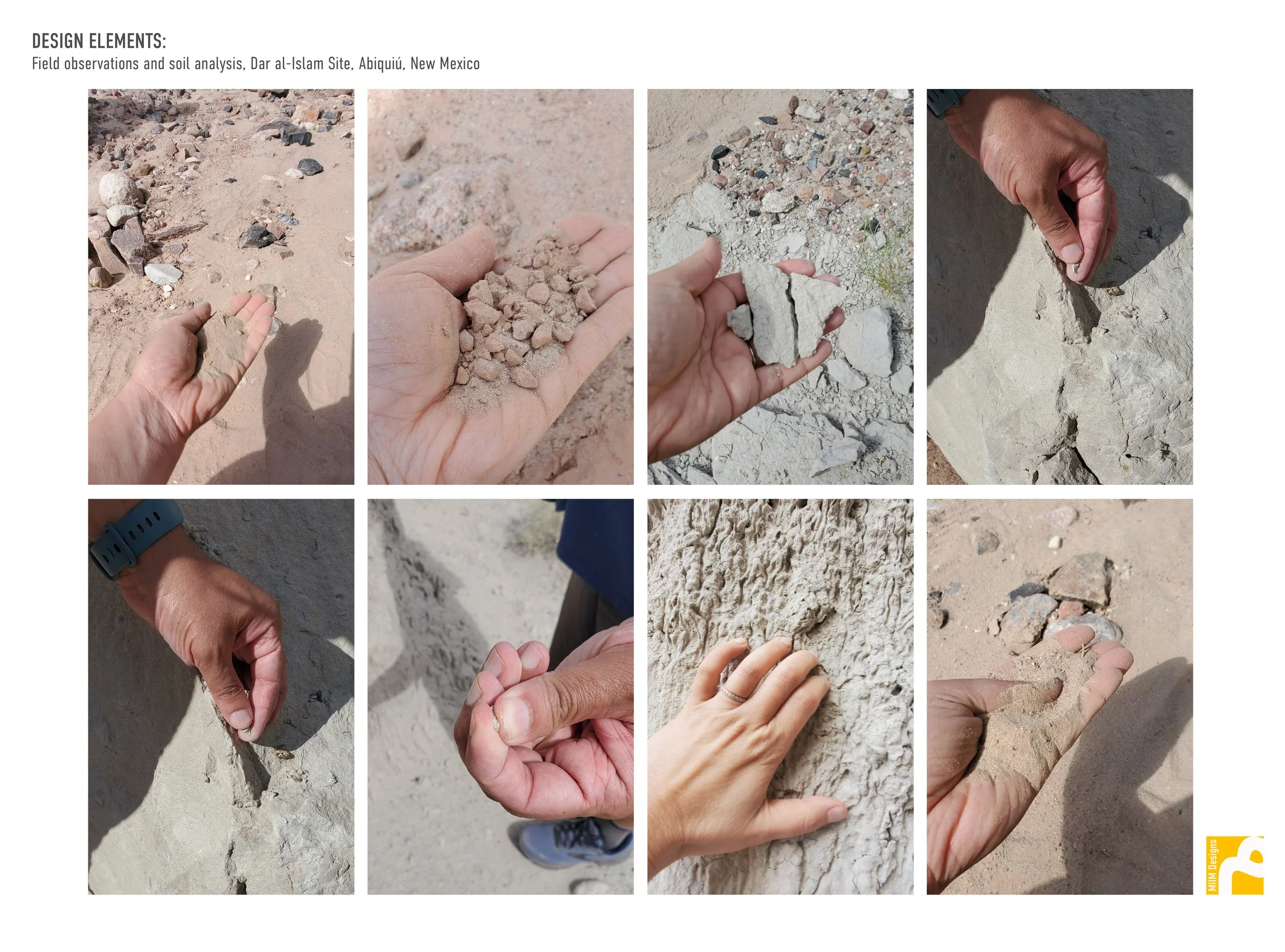
For MIIM Designs, architecture is an evolving dialogue; one that accumulates stories of place, texture, labor, and life over time. Nothing is born from a void. Every project emerges from what came before, shaped by what is already present and by how a place might project itself forward. We understand architecture not as a fixed object, but as a layered condition: cultural, material, environmental, and temporal.
At Dar al-Islam, this understanding becomes tangible in the soil itself. Beyond the layered cultural accumulation produced through community engagement and participatory design - processes that inform the forms and spatial logic of the building - the material choices carry memory. Earth, sediment, and composite assemblies record traces of former lives. Each layer added is not a replacement, but a continuation of an ongoing conversation.
Sediment, for MIIM, is both a physical condition and a conceptual framework. Our design process operates through iteration and accumulation, where each project is shaped by the sedimentation of cultural considerations, environmental realities, past and future use, and emotional undercurrents. Materials are never neutral; they absorb context, labor, climate, and care. In this sense, every MIIM project becomes an imprint of time—shaped by the histories it inherits and the futures it imagines.
Our ongoing research into circular construction economies extends this thinking materially. For a more recent project, in the heart of Abiquiu New Mexico, we have been exploring the possibility of various adobe mixtures and earth–cement composites derived from the site. Recent site observations and 2024 soil analyses reveal how local and imported clays interact within the walls, confirming both intended material behaviors and emerging conservation challenges. These findings raise a critical question: how do we preserve an architecture conceived as a transnational experiment - rooted in Nubian vernacular traditions yet translated to the Chihuahuan Desert - when its substance and cultural life are inherently contingent, porous, and in motion?
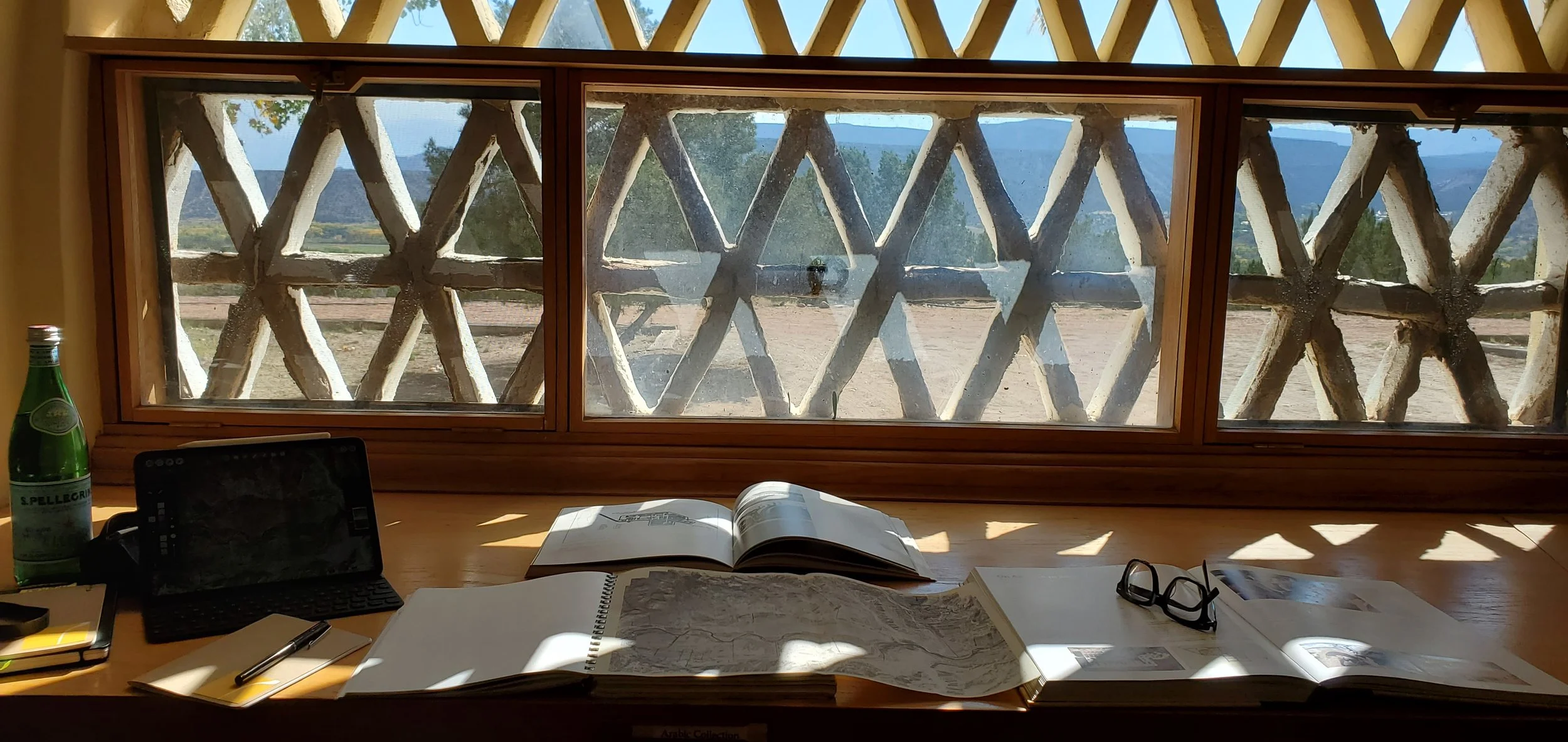
When Hassan Fathy’s imported techniques met the ecology of New Mexico, alignment and friction coexisted. Local masons adapted his vaulting systems with ingenuity, embedding regional knowledge into the construction process. At the same time, these adaptations exposed the limits of transposed vernaculars, the slippages between theory and ground, between universal design ethics and situated craft knowledge. Dar al-Islam thus emerges not as a static monument, but as a palimpsest of negotiations and translations.
Its preservation, then, is less about freezing form than about tracing these exchanges across time: between Egypt and New Mexico, between the universal and the local, between soil, and the evolving ethics of architectural care. Through layering: material, cultural, and methodological, we do not simply build. We compose, allowing architecture to remain responsive, resilient, and alive within the landscapes it inhabits.
Looking forward, this research directly informs MIIM’s future projects and material experimentation as a form of applied research and development. The lessons embedded in Fathy’s only structure in the West, soil behavior, climatic response, structural performance, and the translation of vernacular logics across ecologies—now operate as design intelligence. They guide our continued investigation of earth-based systems, site-derived composites, and hybrid assemblies that leverage excavation residue, mineral sediment, and high-performance binders to produce thinner, more resilient architectural elements suitable for contemporary use.
At MIIM, innovation is inseparable from continuity. Each project functions as a living laboratory, where material testing, prototyping, and performance analysis are embedded within cultural and environmental contexts rather than abstracted from them. By treating sediment not as waste but as resource, and experimentation not as rupture but as accumulation, we advance circular construction economies that are both technically rigorous and ethically grounded. In this way, our work becomes at once a manifesto and method: a growing archive of material knowledge in which past experiments sediment into future form, and architecture evolves through deliberate acts of acknowledgment, adaptation, and transformation.