Pavilion N⁰¹: Craft Contemporary Museum | Cycles of Change
Material + Applications | Los Angeles, California
Invited Competition
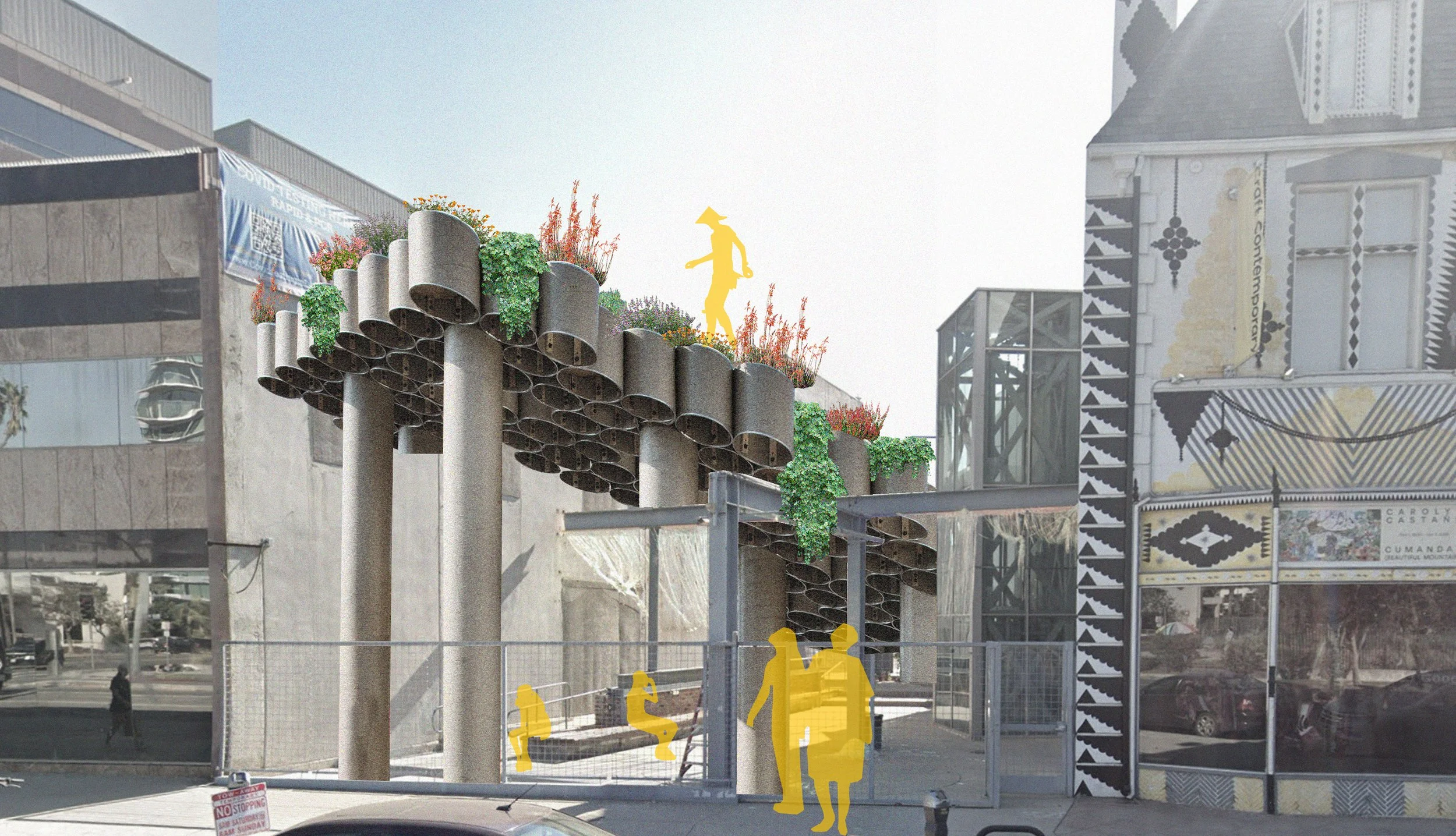
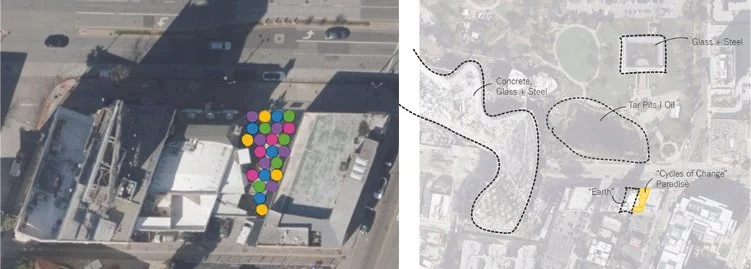
conceptual diagrams
Cycles of Change
Los Angeles never really sits still. Buildings rise, seasons slip, communities overlap, and landscapes keep re-sprouting in ways both natural and entirely improvised. “Cycles of Change” joins that rhythm. For M&A’s courtyard at Craft Contemporary, we’re proposing a living installation, part garden, part classroom, part seasonal stage, where architecture doesn’t just stand there, but breathes, grows, and eventually disappears back into the soil. Forget steel and glass; our raw ingredients are soil, seed, water, sun. We’re working with cardboard tubes, adobe plasters, and natural fibers, materials that shade, filter, and scaffold life. Instead of lasting forever, they’re designed to fade gracefully: walls crumble, canopies fray, gardens seed themselves anew. It’s not demolition; it’s compost. Its Earth.
As you wander through the courtyard, things don’t line up like a blueprint, nope, they unfold like chapters. Adobe meets greenery. Scaffolding turns into canopy. Zones appear like stations in a ritual or steps in a recipe: Earth, Sky, Collection, Cleansing, Pyramid, Reflection, Listening Circle. Each is a small world, an herb grove that smells like cleansing, an alcove for stories, a bed of vegetables ready for foraging and shared meals. Together, they create an unfinished ecology: always in motion, never quite done.
“Cycles of Change” extends M&A’s history of turning ordinary materials into something extraordinary. If past projects exposed the strange beauty of construction tarps, this one flips the script: instead of wrapping buildings-in-progress, we treat the city itself as a farm-in-progress. At the heart of it all is community. Gardening, cooking, gathering, cleansing. The things people already do every day, this time they are reframed as rituals of care and resilience. Programming ties into both ecological and cultural calendars. By summer’s end, the courtyard will be growing more than fifty varieties of herbs, fruits, and vegetables; harvested by visitors, eaten with neighbors, cooked by local chefs.
What happens when architecture is seasonal? When decay is design, and renewal is the point?
Ultimately, “Cycles of Change” is less about building a thing and more about staging a living process. It’s a porous classroom, a fertile stage, a community farm disguised as architecture. Here, growth and care become visible, tactile, shareable. The courtyard turns into a landscape of continual discovery—where the cycles of the earth mirror the cycles of collective life.