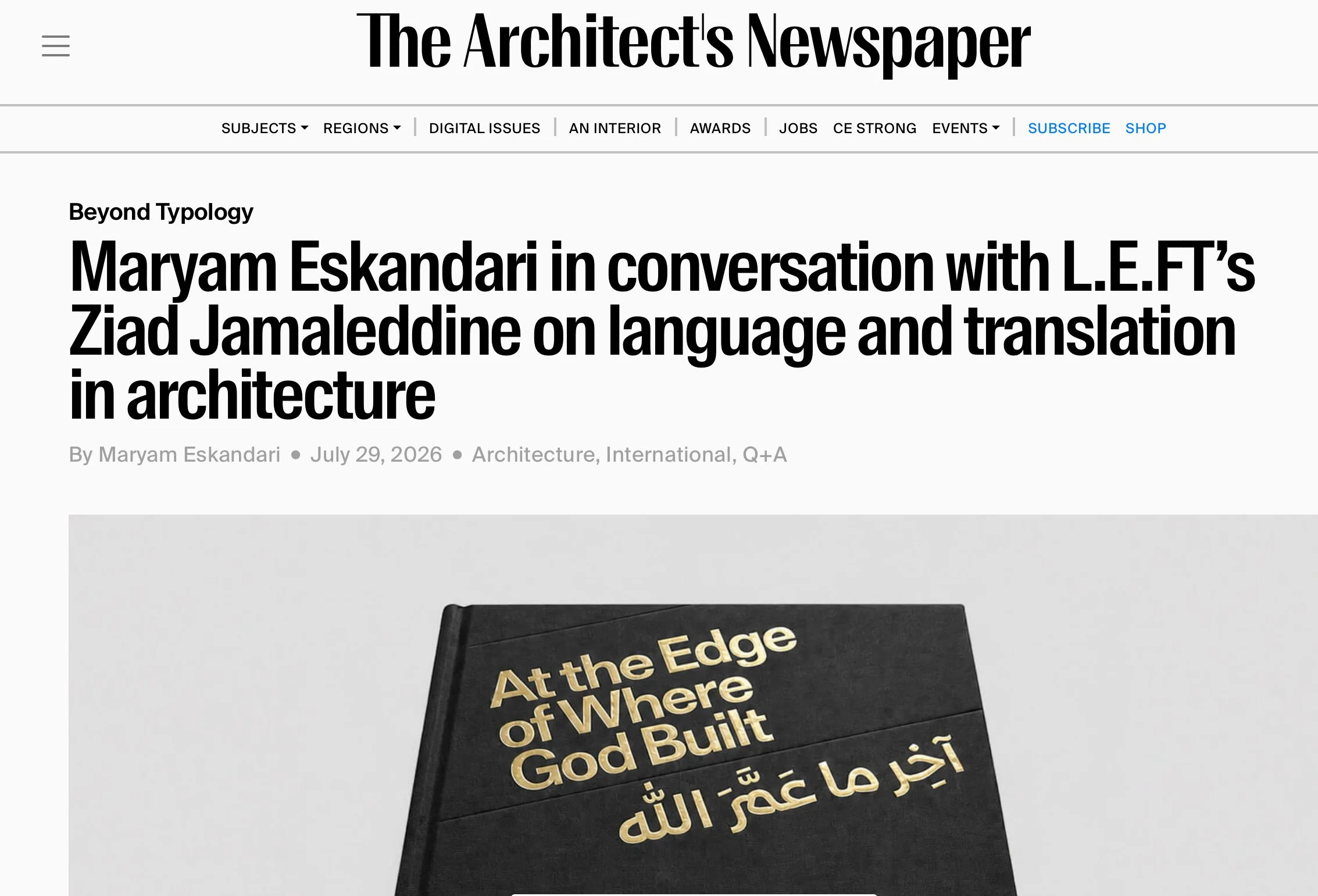
Maryam Eskandari speaks with Ziad Jamaleddine about how language can recover and translate spatial concepts embedded in Islamic architectural traditions, challenging fixed typologies and opening new frameworks for contemporary architectural practice.
Read the interview HERE.
BOOK LAUNCH: L.E.F.T. Architects' Ziad Jamaleddine Launches At the Edge of Where God Built at the MAK Center /
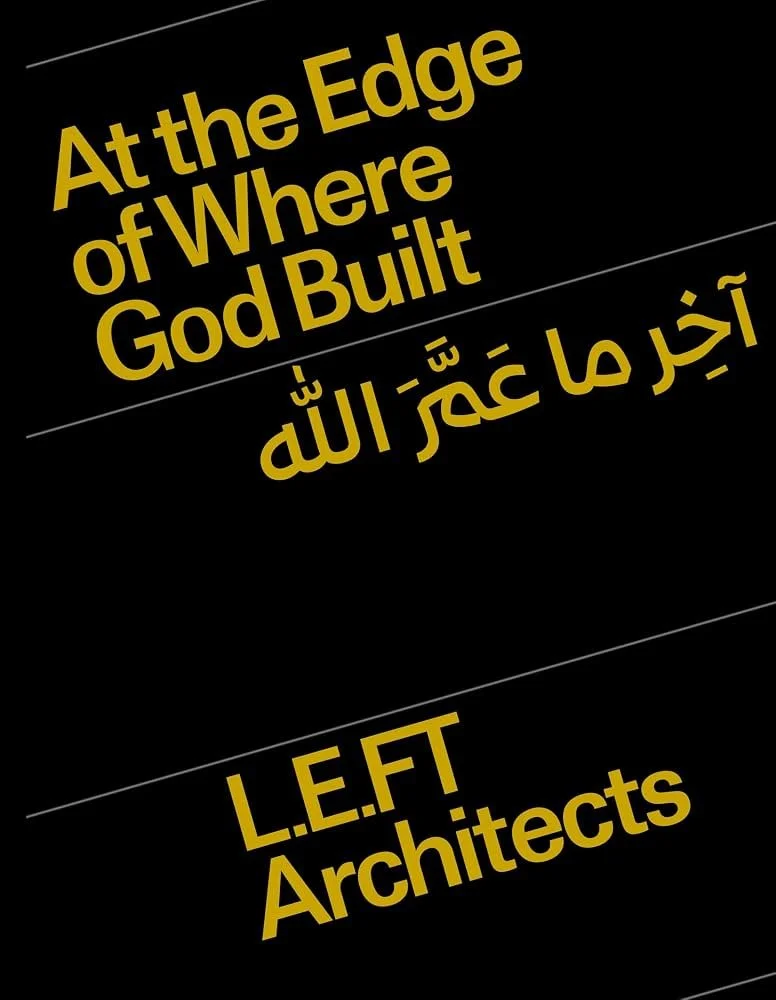
On July 30, 2026, MIIM Designs founder Maryam Eskandari will join architect, scholar, and L.E.F.T. Architects co-founder Ziad Jamaleddine in conversation at the MAK Center for Art and Architecture for the launch of their new book, At the Edge of Where God Built: Language. Concepts. Islamic Architecture.
Taking place at the historic Schindler House in Los Angeles, the event will celebrate the publication and explore the ideas that have informed L.E.F.T.'s architectural practice over the past decade. Through five foundational Arabic concepts—mataf, jami, riwaq, dar, and khirba—the book offers a conceptual framework for understanding Islamic architecture through language, spatial practice, and cultural imagination.
RSVP HERE
Reparative Ecologies of Return: Maryam Eskandari in The Plan Journal /
At MIIM Designs, we’re inspired by projects that expand how we think about ecology, infrastructure, and collective stewardship in urban environments.
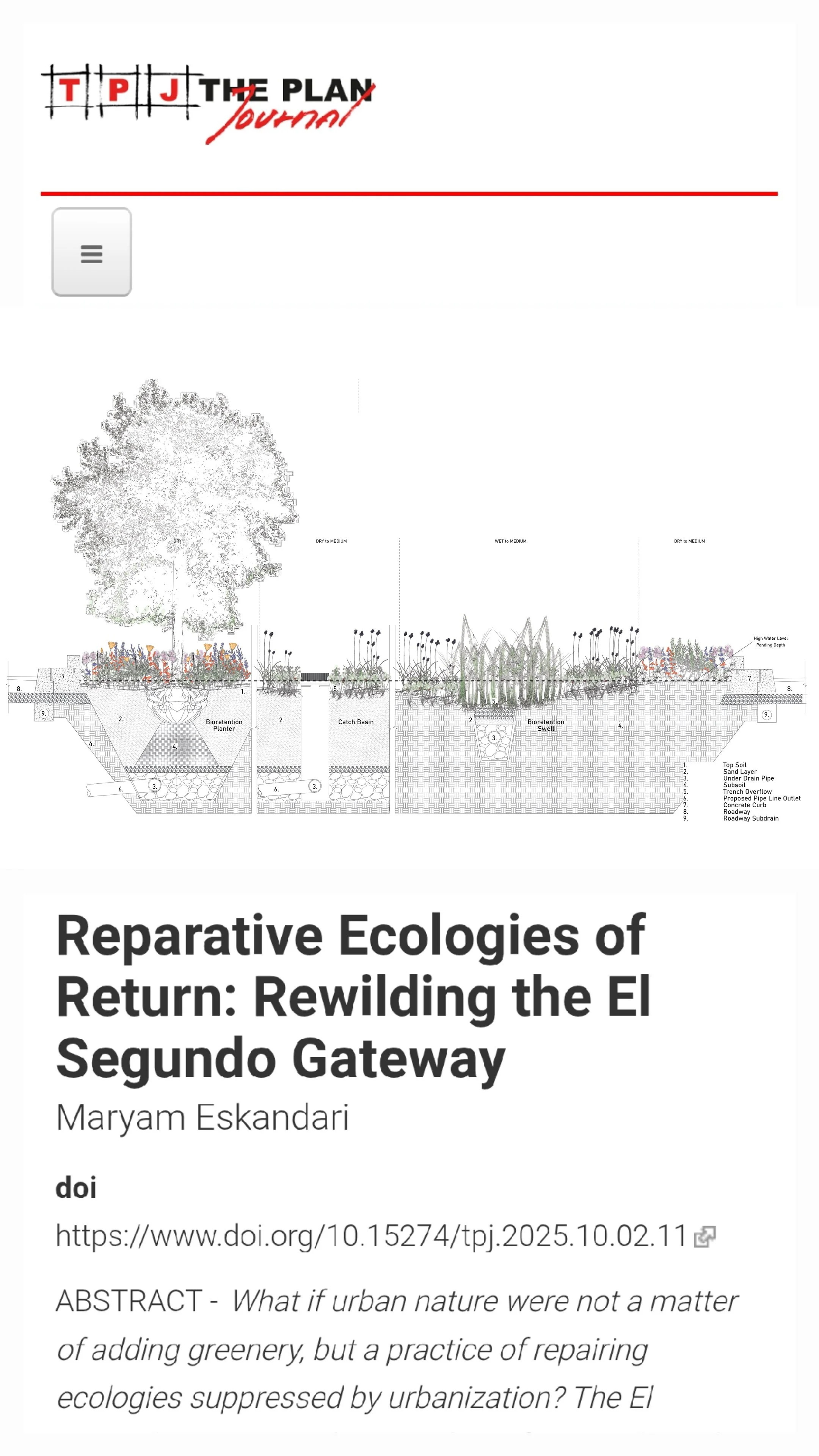
Maryam Eskandari’s article, “Reparative Ecologies of Return: Rewilding the El Segundo Gateway,” published in The Plan Journal as part of the Fall 2025 issue The Nature of Cities, explores how landscape architecture can operate as a framework for ecological and cultural repair.
Situated between the Chevron Refinery and LAX, the project reimagines a constrained urban corridor as multispecies infrastructure — reconnecting hydrological systems, supporting the endangered El Segundo blue butterfly, and translating Tongva spatial knowledge into a contemporary civic landscape.
The work asks us to reconsider urban regeneration not as beautification alone, but as a long-term practice of reciprocity, memory, and care.
Read the full paper:
The Plan Journal Article
Learn more about the project:
Rewilding the El Segundo Gateway Project
HIRING: 2026 Summer Internship /

SUMMER 2026:
MIIM Designs is currently seeking new members to join our architectural team. We are looking for talented and dedicated individuals to fill the positions outlined below. To be considered, please submit a cover letter, resume, portfolio, and a list of three references (including contact information and your relationship to each reference) as a single PDF file (maximum 20 MB) to Studio[at]miimdesigns.com. Be sure to include the appropriate subject line specified for each position. Your cover letter must clearly indicate your eligibility to work in the United States. Due to the high volume of applications, only candidates selected for an interview will be contacted. We appreciate your understanding.
Open Positions:
Research / Publication Associate We are seeking candidates with strong research skills and a demonstrated interest in architectural, urban, and territorial research and discourse. Familiarity with publication processes; including graphic communication and publication management, is highly desirable.
Part-time, remote position
May be combined with other roles for full-time consideration
Ideal start: June 2026
Duration: 6–12 weeks
Subject line: 26 Summer Research Assistant_Your Name
Entry-Level / Junior Designer
Summer Internship
MIIM is seeking a highly talented and dedicated junior designer to contribute to ongoing and upcoming projects. The ideal candidate will demonstrate strong design exploration and representation skills, along with an interest in research-driven and hands-on design processes.
Requirements:
Advanced proficiency in Rhino, Revit, Adobe Creative Cloud Suite, and rendering software
Experience with physical model making
M.Arch (2nd or 3rd years candidate) or B.Arch degree (4th or 5th year candidate)
Authorization to work in the United States
Must be based in Southern California (site visits required; not a remote position)
Ideal start: June 2026
Duration: 6–12 weeks
Publishing as Spatial Infrastructure: Maryam Eskandari in the Schindler House /
Featured on KoozArch, Maryam’s essay reflects on writing from within the Schindler House, which operated as the Reading Room of the MAK Center for Art and Architecture over the summer, to consider publishing as an extension of spatial practice. Moving from modernist manifestos to contemporary independent presses, the text situates printed matter as a form of cultural and political infrastructure, arguing that architecture’s influence is shaped not only through buildings, but through the editorial and civic platforms that frame its discourse.
Read on KoozArch.